Deadline day’s finally over, not that many would have noticed it was there in the first place. Not many would have noticed that Chubby Alonso missed out on his weekly Kicking The Blues column either – this time the blues had well and truly kicked him instead. He’s recovered well though and has stuffed up quite a sizeable wrap. We’ll cut to the chase:
1. It’s A Rich Man’s World
The January transfer window finally came to a whimpering close on Monday with little promised and little delivered. Deals done have been cold and responsible, shy of the ridiculous sums of money that spoilt fans are used to seeing. Indeed, with the influx of foreign owners and the inflation of transfer fees, the January window has quickly grown to crystallise these ABBA lyrics: Money, money, money / Must be funny / In a rich man’s world. While the window remains one of choice for the big boys it has habitually become one of fear for the smaller sides – Burnley and West Brom surely amongst those who could not be more relieved to see the window pass without the sale of their star strikers.
Even with the Financial Fair Play rules, the bigger clubs still enjoy greater asset mobility and are hence better equipped to both gain and lose players. One needs to look no further than the contrasting fortunes of Chelsea and Swansea to see how clubs of disparate financial status find themselves on different sides of the shopping window. When the transfer windows were first introduced by UEFA in 2002-2003, the overarching intent was for squad stability and player preservation, but the way January conducts its business suggests that football has lost sight of that vision. It could be time the game adapted to recognise how much of a business it has become and made an executive change for the better. Could Barcelona – already looking better and brighter this year without any transfer tumults – fortuitously pave the way for the future of transfer windows? Perhaps a transfer quota (once mooted by Arsene Wenger) or even a loan-only window could be in order: Podolski, Salah and Shaqiri are amongst some big names who are benefiting from being released on loan in January and I believe that this could be the most modern, equitable, and enjoyable solution.
2. Same Same But Different

After an extended winter wander, the Bundesliga has well and truly found its way back into our hearts again. If a league table was drawn up from the start of the Rückrunde, both Bayern and Dortmund would be tied on one point after two games, with Bayern slipping into the relegation zone by virtue of a sorry goal difference. Yet such a table tells a lie: Bayern paid a sore price for their tactical mis-step at Wolfsburg, but were terribly unlucky to draw with Schalke, having put in another dominant performance despite playing a whole hour with just ten men. Yes, they were lucky to escape a triple-punishment after an uncharacteristically meek penalty from Eric Maxim Chupo-Moting, but they played with the mastery and confidence of a team eight points in the clear and gave every reason for Pep to be pleased (“I’m not happy, I’m very, very, very happy”).
On the other hand, Dortmund are beginning to look the part of basement dwellers. The team remain too good to go down, but a team that good should have more ambition than that – or at least a whole lot more pride. A ferocious side once feared for their relentless attack have failed to score this new year and were tremendously underwhelming against 10-man Augsburg, an energetic team slowly winning admirers in the same fashion that Dortmund did four years ago. As teams begin to grow accustomed to Dortmund’s stubborn and increasingly weary gegenpressing, Klopp’s approach is starting to look dated and limited. The team look out of ideas, and Mats Hummels and Roman Weidenfeller must surely be out of words.
3. Dream On

Wonderful strikes by Liverpool’s two diminutive forwards on Wednesday mean the Merseysiders are two games from a Wembley semi-final and three games from Steven Gerrard’s Wembley Birthday Bash. Believe it or not, Mr Cup Final’s 35th birthday fittingly falls on the 30th of May, and considering how fashionably late Liverpool left it against Bolton, the stars surely appear to be lining up. Yet such stars already regularly turn out for Manchester United, who are the highest placed team left in the tournament and are officially the favourites for the FA Cup. Against Cambridge United on Tuesday, Louis Van Gaal once again showed refreshing respect for the tournament, fielding a first XI that begrudged even Victor Valdes an appearance. United may have flattered to deceive once again but remain notoriously difficult to beat, priming them specifically for cup success. By their own manager’s own admission, United are in it to win it and by all accounts should: “I am not allowed to bet. But I give you a tip. We have a real chance now”. Gerrard’s Cup Final Birthday may turn out to be a dream, but until then, let no one tell him that.
4. An Ending Fitting For A Start
Deadline day may not be deadline day without Harry Redknapp, but QPR will still be QPR without their resident wheeler-dealer. A reign that began with a bit of fanfare has ended with not a morsel of remorse: it is not an uncommon sight to see ‘Arry leaving a Premier League club, nor is it an uncommon sentiment to say that he will not be missed.
QPR’s form this season has made this decision a matter of when, not if: they boast the unflattering record of failing to register a single point on all their travels so far this season, and in their past 40 away games in the Premier League (harking back to Harry’s first tenure) they have managed just the two wins. But for Charlie Austin’s outstanding goalscoring contributions (54% of QPR’s goals this season), the axe might have fallen earlier; instead he is allowed the dignity of walking away under the guise of a ‘knee surgery’.
It is not the first time Harry has been shown the door, even if it has never been a straightforward sacking. His career has not been characterised by endurance nor excellence, and his pinnacle of achievement was probably an overhyped candidacy for the England job that was subsequently handed to Roy Hodgson. Even at his multiple alma mater he has been known to float on rather than flourish, to buy rather than to breed. His style and busy-ness has created a facade that he is a lot bigger and better than he really is – a pufferfish if you will – and it takes only a few punches and punctures to leave his soft underbelly exposed and deflated.
His best finish as a manager in the Premier League was with a Spurs side free-rolling with a budding Gareth Bale, but what his fans like to forget is how close he came to letting Bale go, and how persistent he was at confining the Welsh winger to the left back role. His questionable eye for talent has finally backfired at QPR: Rio Ferdinand failed to be the force he thought he was, and Harry failed to be the man he made himself out to be.
The writing was all over the wall for Deadline Day incumbent Harry Redknapp. As February the First passed by at QPR with one fateful tweet and no frisky treats, so would ‘Arry’s time at the club on February the Second.
5. Equatorial Guinea: Finally On The Map
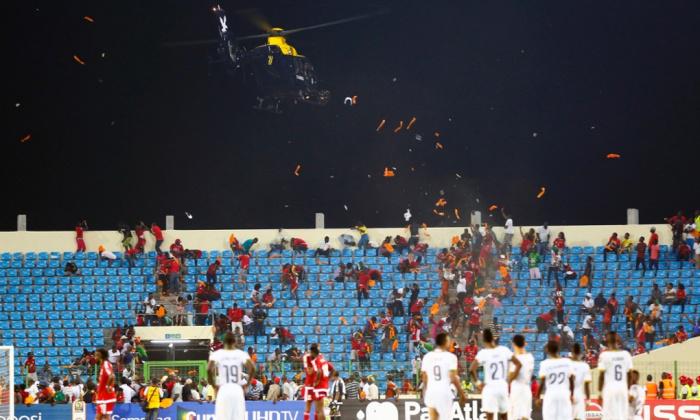
Last night, Equatorial Guinea were faced with a golden chance to set the continent alight, but instead ambled off the pitch under some pretty dark clouds. Just two months ago they had emerged as a sort of hero after Morocco pulled out of hosting the Cup of Nations at the height of Ebola fears, offering to do so despite the short notice. Probably the weakest nation in the competition, they had made it to the semi-finals, already surpassing all expectations and making history for the young footballing nation. 90 minutes stood between them and greater glory, but 45 was all it took for the wheels to start coming off.
2-0 down at half-time, the Equatorial Guinea fans had already begun pelting objects at the Ghanian players, who left for the dressing room under a Spartan-esque formation of riot police shields. On the pitch their players put on a disgraceful show of gamesmanship – soft falls, terrible tackles, the whole lot – almost in recognition of their inferiority, almost with such disregard to the home support. When Jordan Ayew slotted home Ghana’s third goal things got ugly: anything that could be thrown was sent flying at Ghanian players and fans alike; a helicopter emerged, hovering low and causing more chaos and confusion than any semblance of calm; the faction of Ghanian fans that left the stadium early found themselves in the hands of an expectant mob, fists full of fury. As the violence simmered down, all that remained was an odd sense of fear: first for safety, then from the growing realisation of a legacy ruined for the competition, the country, and the continent.



 Chubby Alonso